Want to Try a Measure by Measure Lesson FREE?
Get "How To Read Music - Quick!"

Where Can I Send Your First Lesson?
NOTE FROM RANDY: Check the box above to receive a free lesson from Measure by Measure and join my email newsletter. You can unsubscribe at any time, and I will never share your information with anyone.

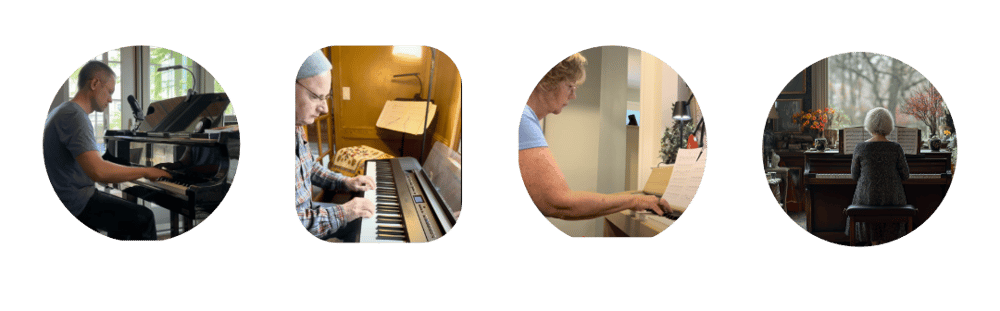
Discover How beginners unlock their piano reading skills so they never hit the "sheet music wall"
How to practice with sheet music so you can learn songs faster right from the beginning!
“The biggest revelation was that I could start with real music that I wanted to play instead of starting with a method book that was designed for kids.”
- Kathy Lewis (member)
Join 'Measure by Measure' And Get ...
THE BIG BEGINNER BUNDLE
FREE!
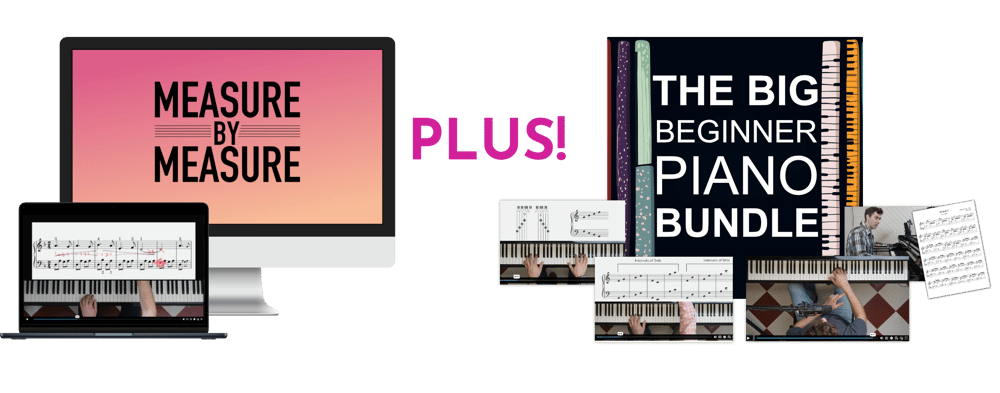
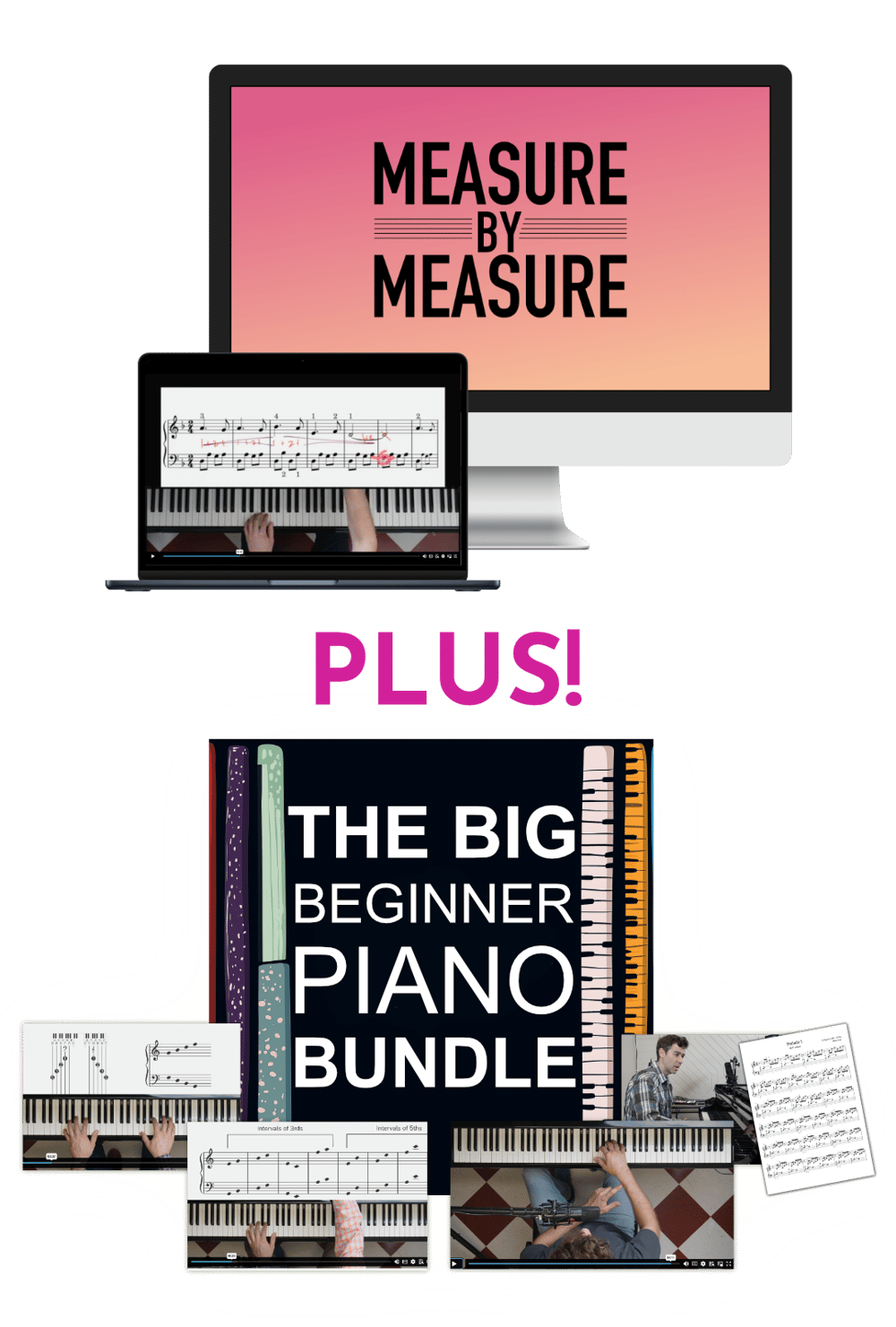
Try my program, 'Measure by Measure' and get these music-literacy-focused beginner courses FREE as a thank you!
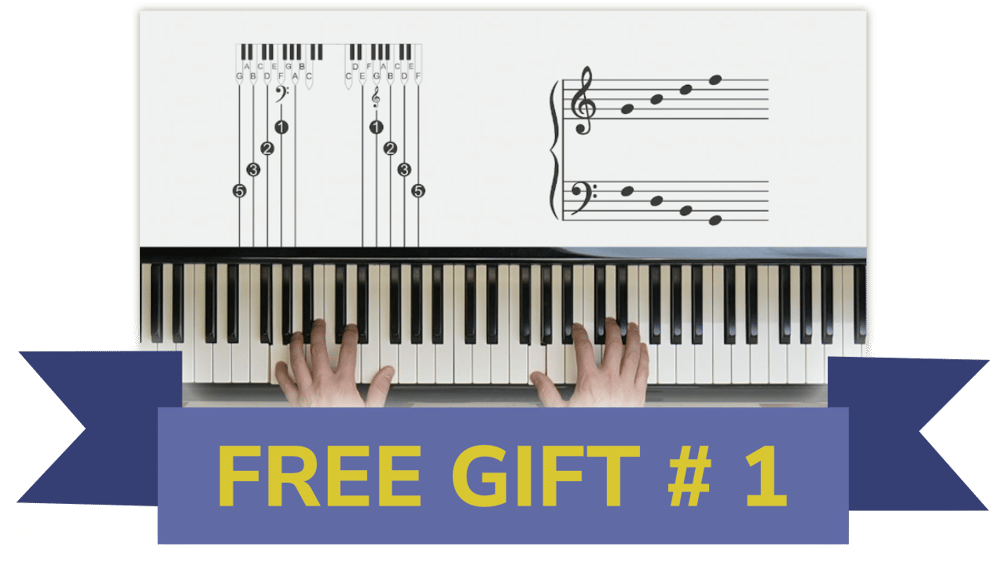
$97 Value
THE STAFF-TO-KEYS SOLUTION
A UNIQUE APPROACH TO BEGINNING RIGHT
Don’t just learn the note names, learn to GO to the keys with expert efficiency. With the Staff-to-Keys solution you’ll learn to read music comprehensively so you can skip the infantilizing method books and get right to real music.
BEYOND THE NOTES
RELATIONSHIPS IN PIANO READING
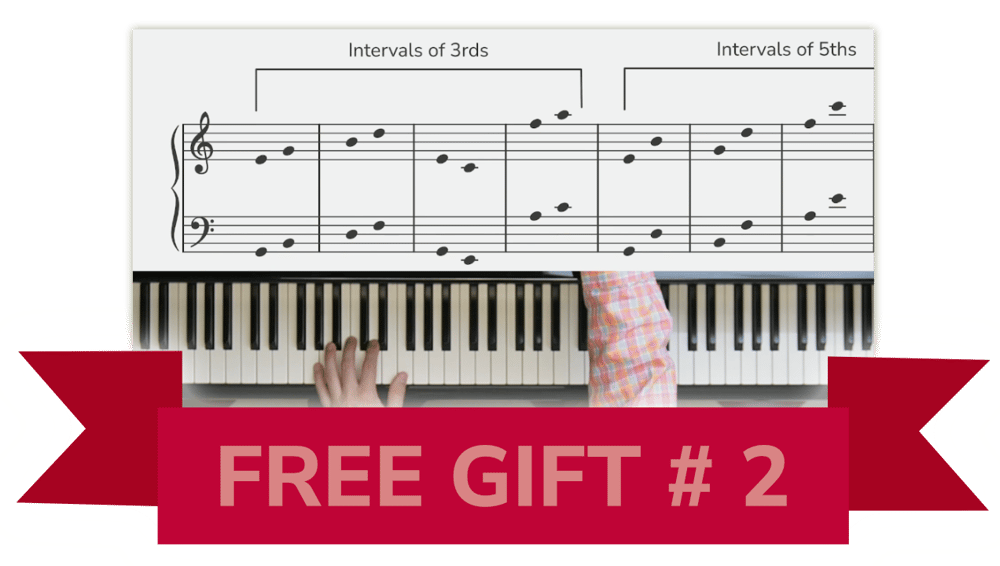
Learn to read music (the professional way) by comprehending multiple notes at once. With Beyond the Notes you’ll super-charge your sheet music reading by learning how the notes fit together in musical relationships.
$120 Value
$180 Value
BEYOND THE NOTES
RELATIONSHIPS IN PIANO READING
Learn to read music (the professional way) by comprehending multiple notes at once. With Beyond the Notes you’ll super-charge your sheet music reading by learning how the notes fit together in musical relationships.

$80 Value
7 HABITS FOR BEGINNER SUCCESS
ESSENTIAL BEGINNER TECHNIQUE
Set up your technique with these critical habits. The 7 Habits For Beginner Success apply to every note you will ever play, from the very first touch of the piano to your most virtuosic future performance.
THE GENESIS OF PIANO
BACH'S PRELUDE IN C
The one piece of music I truly believe every pianist should learn no matter what is Bach’s Prelude in C. The “Genesis” of piano music started with Bach’s compositions in every key, which celebrated what keyboard music could really be. This prelude is not only beautiful, it’s an opportunity to practice piano literacy habits that will set you on a course to become a truly gifted Piano Reader.

$200 Value
$200 Value
THE GENESIS OF PIANO
BACH'S PRELUDE IN C
The one piece of music I truly believe every pianist should learn no matter what is Bach’s Prelude in C. The “Genesis” of piano music started with Bach’s compositions in every key, which celebrated what keyboard music could really be. This prelude is not only beautiful, it’s an opportunity to practice piano literacy habits that will set you on a course to become a truly gifted Piano Reader.
Access The Full Library of
Measure by Measure

- 5-Finger beginner pieces
- extensive INTERMEDIATE collection
- Deep-Dive piano Principles
- Count out loud rhythm training
- Sight Reading Secrets
- Practice Frameworks
- scales and technique lessons
- AND Much More!

Join Measure by Measure and get the Big Beginner Bundle FREE.
AND, you can keep the beginner courses forever, even if you decide not to continue your membership.
How beginners unlock their piano reading skills so they avoid the sheet music wall
And how they connect to intermediate piano repertoire faster than ever
Are you convinced you need to play endless warm ups and countless drills to learn piano?
I was.
Sadly it took me thousands of hours of practice and a few years of college music classes until I realized that what worked best is learning the right music with the right approaches.
Worse, most of my fellow students were convincing me I needed to crank up my effort, put in more hours, and sacrifice everything just to play piano like I wanted to.
Somewhere during my Master's degree in piano performance I gave up on the idea of becoming a piano professor. Instead I focused on teaching real people with interests that included more than playing the hardest pieces in the world.
The result? They learned how to play the piano just like me, only they didn't have to go through the same process.
You see, I treated every new student as though they already knew pretty much everything contained in piano method books.
Instead, we focused on playing real music that sounded awesome.
Studio-style repertoire training
In a college piano lesson, it doesn't start with a checklist of scales and exercises.
Most of the time, you arrive at your lesson and the professor asks "what would you like to play today?"
You then play the repertoire you've been practicing.
They help you refine it. You might only play about four measures in your lesson because they have so much to say and teach you about the music.
That's the secret. The lessons are in the repertoire.
The online piano problem
While online piano programs have endless modules of exercises, tips, tricks, and gimmicks. It's not how accomplished musicians have learned for generations.
If your goal in learning piano is to be able to play beautiful music, most of that happens when you refine your piano pieces. The products of that practice will result in greater skills and musical knowledge that only comes through experience.
But what pieces should you practice? And how should you approach them?
One of the greatest teachers I've ever met mentored me in my own teaching. He told me "when you learn it's all about getting your students in the right pieces, you'll see more progress".
Ever since then I've taken great lengths to find the piano pieces that work best for piano students.
It isn't the "100 Greatest Hits!" It's a unique collection of pieces from old teachers who studied with and even taught the masters.
For instance, Karkonov was the teacher of a young Sergei Prokofiev (yes, of Peter and the Wolf). I wouldn't dream of giving a Prokofiev piece to a beginner, and it takes quite a bit of effort to play even his easiest pieces. But the music of Karkonov is great for students. It's the music that may have helped produce some of the great composers.
There are other composers, like Leopold Mozart (father of Wolfgang) and Kirchner (friend of Brahms and Clara Schumann). Composers like Thomas Attwood (Mozart’s student), Carl Reinecke (a protégé of Mendelssohn), Burgmuller, Gedike, Heller, Scharwenka and many many more!
They wrote miniature masterpieces, but these pieces are more accessible to pianists who don't necessarily practice for hours a day. They require the same skills to play, but a fraction of the discipline and dedication.
Some of the beautiful pieces featured in the Measure by Measure lessons
Handel-Halvorsen
Passacaglia
This piece is a transcription of a piece written for Violin and Viola by GF Handel. Halvorsen arranged it for piano and it's one of the most beautiful "Passacaglia". What makes it great is the opportunity to build a theme over a repeated left hand pattern, which also prepares you for music with challenging left-hand, like works by Chopin and other romantic composers.
Flotow: Prayer from the Opera "Stradella"
This prayerful melody gives you the chance to practice balancing between the hands, shaping a phrase in the right hand, and controlling a left hand accompaniment. Not only will you learn great skills, you'll sound beautiful in the process.
Moniuszko - Chimes from the Opera "The Haunted Manor"
Opera transcriptions often provide excellent music for beginner and early-intermediate students because it was composed with the intention of telling a story. While most of the well-known piano composers wrote most of their pieces in well-known forms (like Sonatas), they don't exactly spark the feeling of a story. Imaginative playing can come from many places, but I love pieces like this that showcase a relatable enchanted vibe.
Heller, Op. 138 No. 19 - Tziganyi
Inspired by Hungarian folk music, Stephan Heller composed many short pieces that are beautiful, fun to play, and teach amazing piano skills. Playing music like this before trying to tackle Liszt, Chopin, or Scriabin is a must.
Why you need principles,
not method books
When I was teaching 40+ students every week I learned what nearly everybody struggles with in their learning experience. I found myself repeating the same things over and over for every student. Several years into teaching I realized I had to teach differently if I didn’t want to burn out from nagging and pleading with my students.
I knew that if I could just help them understand the “why” of piano technique, and of music literacy, they would govern their own behavior and wouldn’t need constant badgering from me.
I also knew that my own practice boiled down to just a few good habits repeated consistently. The simplest of approaches had always given me the best results, so I stripped my teaching of extra nonsense (stuff I’d always been told I “should” do as a player and teacher) and instead focused on just a few principles. The result turned into what I offer in the Measure by Measure “Principles” lessons.
The Piano Reader Solutions that increase your music literacy and playing skills at the same time
The 4-Measure Promise
First, we’ll simplify your approach with low-effort, high-leverage practices that are guaranteed to advance you in the music. Not only will you have a systematic way of working through your music, you’ll have a framework that you can apply to any music at any stage of your learning.
Turn the note-learning process into an easy warm-up that you’ll do first thing, then summon your creativity early in your practice to make every new phrase fun to learn. You’ll play expressively and beautifully every day with less effort. You’ll validate your new practice system by learning and recording (and sharing if you choose) newly-learned sections of your music.
Sight Reading Secrets
When you know the actual visual, tactile, and aural mechanics that maximizes your practice, reading music feels fun! Developed over 17 years (and more than 10,000 hours of observing people learn to read music), Sight Reading Secrets will teach you the “secrets” only the best sight readers know (but can’t actually express it to you, even if you ask them). You will engage your personal music strength (you have one, and if you don’t know it I’ll help you discover it). Taking that personal strength you’ll learn to exploit it while you read sheet music. You will support your new Super Power in the context of spontaneous sight read and learning the repertoire of your choice to summon your latent skills and let them blossom.
The Repertoire Refinery
With a high-yield practice and a newfound super power in place, you'll unlock the ability to learn new music faster than ever. With The Repertoire Refinery you'll then put the mechanics of piano playing into context. You’ll learn the ability to dismantle any music into its essential parts and solve every problem, all while refining music you can play and perform. You validate your Repertoire Refinery by learning pieces of your choice, then sharing magical moments from your practice with the Measure by Measure community.






"Measure by Measure"
Frequently Asked Questions
Measure by Measure is designed for beginner and intermediate piano players. So even if you're just starting, especially if you're just starting, Measure by Measure is for you!
The Repertoire Refinery is full of hidden gems especially for intermediate students. Yes - Measure by Measure is great for intermediate students, all the way to early-advanced students.
Like any program, you get out what you put in. Decide what consistent practice looks like for you. If that’s twice a week, that’s a great place to start! My "4-Measure Promise" is this: If you can sit down and learn 4 measures of music, twice a week to start, you’ll see tremendous progress.
It is self-paced. I'm here to point you in the right direction and answer questions whenever you need.
Yes. You need some device to access to the content - your phone will work, but a tablet or computer with a bigger screen is ideal.
Measure by Measure is a subscription membership. To access any of the content you’ll need a current subscription. You will lose access to the content after the end of your last-paid month of membership once you cancel. Exceptions are for the Big Beginner Bundle or other special offers. See the Terms of Service for more details.
Yes. You can cancel any time. After you cancel you won't be charged again.
There is no free trial unless specified above. There is no money-back guarantee. Your month-to-month payments are nonrefundable, but you can cancel any time.
Yes. $270 per year saves you $54 and grants you access to the Technique module.
You can upgrade to annual at any time and it will prorate your current billing period towards the annual.
Mostly classical music.
You can apply the principles you learn to any other music. With this approach, you will see more carry-over than you can imagine.
I use classical music for a couple of reasons - one is to make sure that I comply with all copyright laws.
My experience teaching piano for over 20 years also taught me that this music is the best venue for learning skills at the piano, regardless of your goals. If you want to play classical, jazz, pop, gospel, or anything in between, there is no disadvantage to learning classical music as your foundation, but huge disadvantages if you do not. It will only serve you in the long run.
Umm, yes! That’s my whole thing.
Yes, there is a community feature to the program for asking questions and feedback opportunities. I consider the community a “perk”, not a core feature of the program. It’s there for us to use and I engage in it as best as I can, but it’s not required for your use of the program.
I answer every question that comes up in the community (give me a day or two), but I can’t guarantee that I’ll have time to personally answer every concern that comes up.
TRY "MEASURE BY MEASURE" TODAY AND GET THE BIG BEGINNER PIANO BUNDLE FOR FREE
THE STAFF-TO-KEYS SOLUTION
A UNIQUE APPROACH TO BEGINNING RIGHT
BEYOND THE NOTES
RELATIONSHIPS IN PIANO READING
BEYOND THE NOTES
RELATIONSHIPS IN PIANO READING
7 HABITS FOR BEGINNER SUCCESS
ESSENTIAL BEGINNER TECHNIQUE
THE GENESIS OF PIANO
BACH'S PRELUDE IN C
THE GENESIS OF PIANO
BACH'S PRELUDE IN C
Access The Full Library of
Measure by Measure
- 5-Finger beginner pieces
- extensive repertoire collection
- Unique intermediate pieces
- piano mechanics training
- Proven practice principles
- Deep-Dive piano lessons
- Count out loud rhythm training
- Sight Reading Secrets
- Practice Frameworks
- scales and technique lessons
- AND Much More!
Experience Your Next "Unlock"
Join "Measure by Measure" Today